
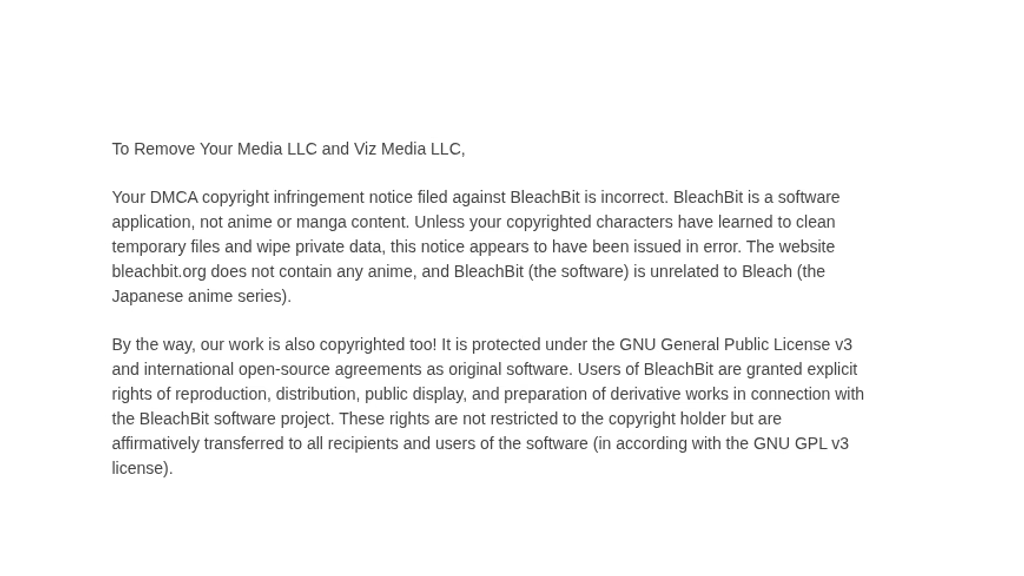
A one-line summary of the news: BleachBit — free, open-source software that deletes temp files and cache junk — received a DMCA takedown notice intended for the anime Bleach. The BleachBit team’s public reply is, politely, one of the funniest legal correspondences to hit the open-source world this year.
What Actually Happened
BleachBit.org now hosts a page addressed directly “To Remove Your Media LLC and Viz Media LLC,” pointing out that the notice appears to confuse a software project for wiping temporary files with a 16-season anime about a teenager who fights soul-eating monsters with a giant sword. The BleachBit team’s rebuttal walks through the obvious: the software runs on computers, not manga panels; its “protagonist” is your hard drive, not Ichigo Kurosaki; and nothing on bleachbit.org resembles licensed anime footage, artwork, or audio. The team also notes, accurately, that BleachBit’s own code is open-source under the GNU GPLv3, which already grants users broad rights to copy, share, and modify it — the opposite problem a copyright complaint is supposed to solve.
The DMCA notice itself, reproduced on the page, names Remove Your Media LLC as the party representing the rightsholder, and describes the “infringing” material as the Bleach anime’s episodes, artwork, and promotional materials — a description that has nothing to do with a disk-cleaning utility.
This Isn’t an Isolated Glitch
The timing isn’t coincidental. Over the past several weeks, YouTube “Bleach” reaction channels — creators who film themselves watching and reacting to the anime — have reported a wave of copyright strikes from the same enforcement outfit, in some cases with multiple strikes landing within days of each other, enough to threaten full channel deletion. A Change.org petition currently circulating asks YouTube to audit and revoke Remove Your Media’s API access, arguing the strikes are being fired off indiscriminately at fair-use commentary rather than piracy. It’s not hard to imagine an automated keyword sweep for “Bleach” catching a piece of open-source software with a very on-the-nose name.
So Who Is Remove Your Media LLC?
Digging into the paper trail, a picture emerges of a small anti-piracy contractor that has represented Viz Media and, more recently, Crunchyroll, and that Anime News Network has confirmed acts on Viz’s behalf. Its principal is widely identified in press coverage, forum threads, and its own past public statements as Eric Green, operating out of Plano, Texas. By the company’s own description, its work involves large-scale, largely automated search-engine delistings, hosting and registrar takedowns, and social-media enforcement, and Google’s transparency reporting shows Viz-linked takedowns (submitted directly and through third parties like Remove Your Media) numbering in the hundreds of millions of URLs — enough volume, by some tallies, to rank among the top submitters to Google’s copyright removal tool, alongside major music-industry trade groups.
That scale comes with a well-documented history of overreach. Independent write-ups and archived social posts stretching back to at least 2015 describe: takedowns issued against blog posts and forum threads that contained no actual video links; a period in which the company published counter-notice senders’ home addresses and phone numbers in a public “transparency report,” a move TorrentFreak covered at the time; strikes against Etsy shops selling clearly-labeled fan art and even wholly original character designs; and multiple cases where the company or its partners later admitted a takedown was a mistake and reinstated the content. Critics have also pointed out an inconsistency: large print-on-demand storefronts that host enormous volumes of unlicensed anime merchandise appear to go untouched, while individual creators on Etsy and YouTube face repeated strikes.
None of this makes the underlying job — protecting a licensor’s copyrighted anime and manga — illegitimate. Piracy enforcement is a real business need. But a takedown apparatus operating at industrial scale, built on automation, is exactly the kind of system that eventually DMCAs a file-shredding utility for allegedly infringing on a cartoon about ghosts. An operation that files removal requests by the hundreds of millions a year could not, on this occasion, spare the ninety seconds required to open bleachbit.org and notice the complete absence of Soul Society — a research failure that would get a first-year paralegal sent back to document review.
The Mismatch, in Perspective
BleachBit is maintained largely by one person, Andrew Ziem, and a small volunteer community — no legal department, no compliance team, just a maintainer who apparently had to stop and explain, calmly and with a comparison chart, that a program which deletes browser cache is not a 700-chapter shōnen franchise. On the other side sits an enforcement operation with the throughput to contest a meaningful share of all copyright takedown requests Google receives in a given year. It’s a mismatch in resources, if not in the merits of this particular argument — and on the merits, BleachBit’s case answers itself.